Wong Tai Sin No. 63 Fortune Stick
Yan Hui Finds Joy in the Way and is Content in Poverty
The ancient figure named Yan Hui.
Wong Tai Sin No. 63 Fortune Stick
Yan Hui Finds Joy in the Way and is Content in Poverty
A humble alley, a simple basket and gourd,
bring no sorrow, others see this and worry greatly.
They do not know the joy of the Way makes one forget poverty and want,
the fragrant name of the Second Sage is left for eternity.
ALLUSION
Allusion
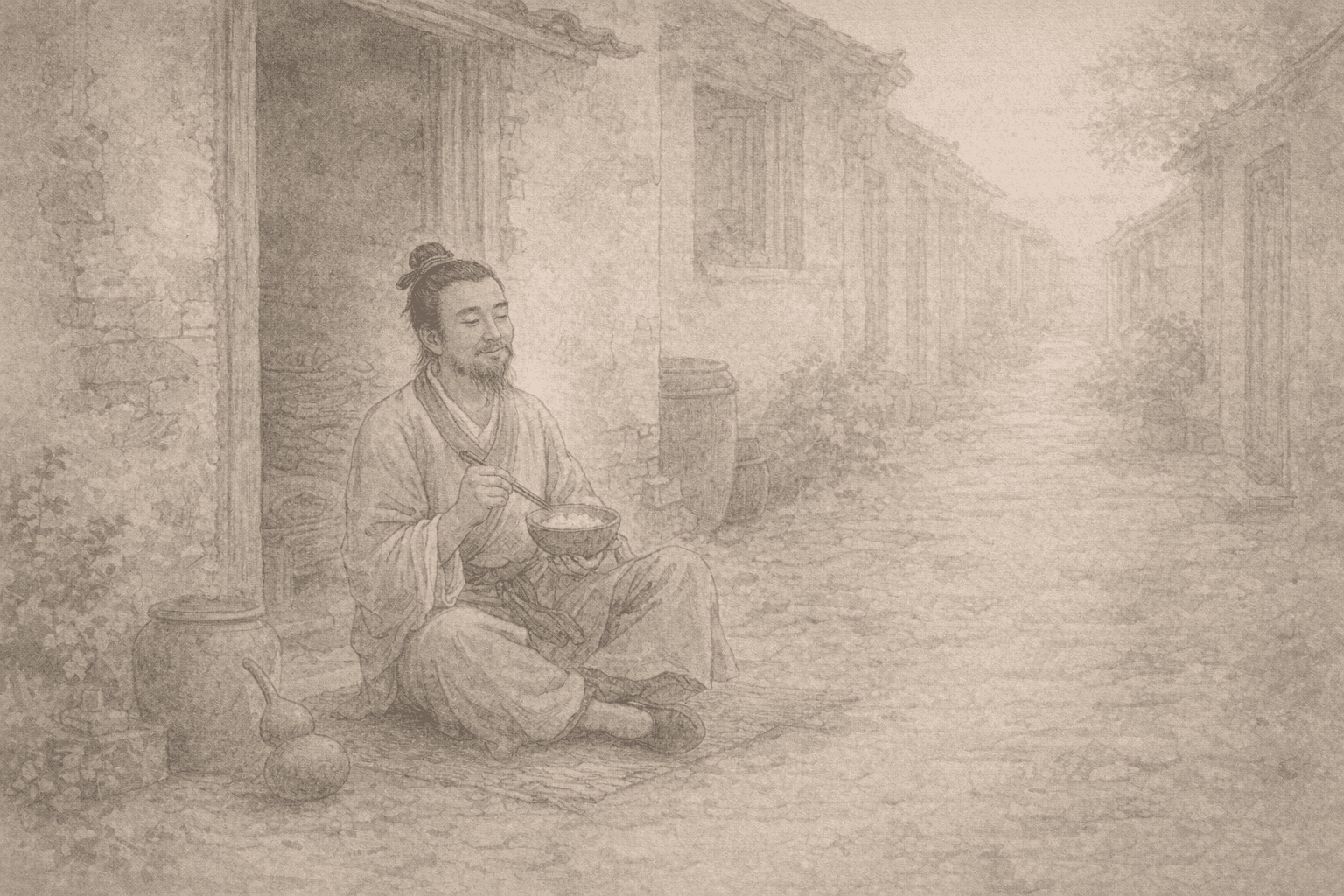
The ancient figure named Yan Hui. With a single basket of food and a gourd of drink, he lived in a humble alley. Others saw this and worried greatly, but Yan Hui found joy in his own path. He did not perceive his own poverty. His efforts reached the level of a sage, leaving his name for eternity.
Those who draw this lot must endure hardship and suffering in all endeavors. They should not be attached to any wealth or profit. Sincerely cultivate goodness, and then reality will lead to reputation, leaving a name that will not decay. Even if one remains poor for life, it is no hindrance. This lot contains good fortune and no misfortune.
Yan Hui, a native of the State of Lu during the Spring and Autumn period, was a good student of Confucius. The world honors Confucius as the 'Supreme Sage,' and some have also called Yan Hui the 'Second Sage.' However, later generations mostly bestowed the title 'Second Sage' upon Mencius, instead calling Yan Hui the 'Restored Sage.' This lot contains Confucius's praise for Yan Hui: Yan Hui is truly a virtuous man. He found joy in the Way and was content in poverty, living in a humble alley with only a bowl of rice and a cup of water. Others saw his circumstances and worried for him, but he was free from worry and sorrow. The world should know that if a person can concentrate on learning and cultivating the Way, they can forget about poverty.
INTERPRETATION
Reading the sign
Original text
Household auspicious; illness can be cured.
Fame and profit: do not entertain wild thoughts.
Silkworms and livestock: profit can be obtained.
Plans and aspirations: caution is advisable.
Marriage can be settled; travel gradually returns.
Regarding pregnancy: no cause for alarm.
Regarding feng shui: stable and unobstructed.
Regarding lost items: searching may not yield results.
Regarding oneself: the body and pregnancy are also safe.
Regarding weather: accept fate, no need to worry.
Regarding travel: bitterness contains a sweet taste.
Plain-language signals
- Feng Shui
- Smooth and without hindrance
- Lost Items
- Searching for it, not yet found
- Self
- Be content with your lot and you will have peace
- Heaven's Timing
- Knowing fate brings no worries
- Travel
- Bitterness holds a sweet taste
- Planning Affairs
- Be careful and cautious in planning matters
- Wealth Luck
- Do not force the pursuit of fame, profit, or wealth
- Children
- No fright, no danger; the fetus will be delivered smoothly
- Academic Studies
- Diligence will bring its own success
- Career
- Do not force it
- Marriage Fate
- It is a good time to marry
- Household
- Family is well, no need to worry
- Illness
- Illness can be treated
FAQ
FAQ
What does Wong Tai Sin Sign 63, “Yan Hui Finds Joy in the Way and is Content in Poverty,” mean?
Start with the interpretation: The ancient figure named Yan Hui. With a single basket of food and a gourd of drink, he lived in a humble alley. The allusion matters too, because this sign should be understood through the people, circumstances, and timing behind the poem, not only as a lucky or unlucky label. The story context also points to this: The ancient figure named Yan Hui. With a single basket of food and a gourd of drink, he lived in a humble alley.
Is Wong Tai Sin Sign 63 a lucky sign?
Its formal level is “Above Average.” That gives you a starting point, but the practical reading is still about The ancient figure named Yan Hui. With a single basket of food and a gourd of drink, he lived in a humble alley. In other words, this sign is more useful as a grounded reading of your current question than as a vague lucky-or-unlucky label.
What does Wong Tai Sin Sign 63 suggest for planning and career?
In the plain-language signals for this sign, planning is “Be careful and cautious in planning matters” and career is “Do not force it.” If your question is about a project, a role change, work momentum, or professional direction, these two lines are more useful than only asking whether the sign is good or bad.
What does Wong Tai Sin Sign 63 say about wealth, business, and timing?
For money and execution, the sign reads wealth as “Do not force the pursuit of fame, profit, or wealth” and business or dealings as “read it inside your deal or timing question.” If you are asking about revenue, cooperation, negotiation, signing, or whether the timing is right, these signals are the clearest plain-language reading on the page.
What does Wong Tai Sin Sign 63 suggest for relationships and marriage?
For relationship questions, the sign gives marriage as “It is a good time to marry” and household or relationship atmosphere as “Family is well, no need to worry.” If you are weighing a bond, a commitment, or the direction of a relationship, these two signals are the best place to start your reading.
What should I do after reading Wong Tai Sin Sign 63?
Read the poem, the allusion, and the plain-language fortune signals as one whole answer to the same question. First decide what you are really asking, then use this sign to judge where to move, where to wait, and where to leave room. If you want to keep going, continue the same question inside Cantian AI for a fuller reading flow.
NEXT STEP
Draw a Wong Tai Sin Fortune Slip Now
Bring the one matter you most want to clarify right now and see what kind of direction, reminder, and answer this slip may offer.